> For the complete documentation index, see [llms.txt](https://docs.mathewscompany.com/llms.txt). Markdown versions of documentation pages are available by appending `.md` to page URLs; this page is available as [Markdown](https://docs.mathewscompany.com/pinnacle-2020/pinnacle-20-or-20-controls/system-settings/discharge-speed-control/accudry-settings/how-accudry-works.md).
# How AccuDry Works
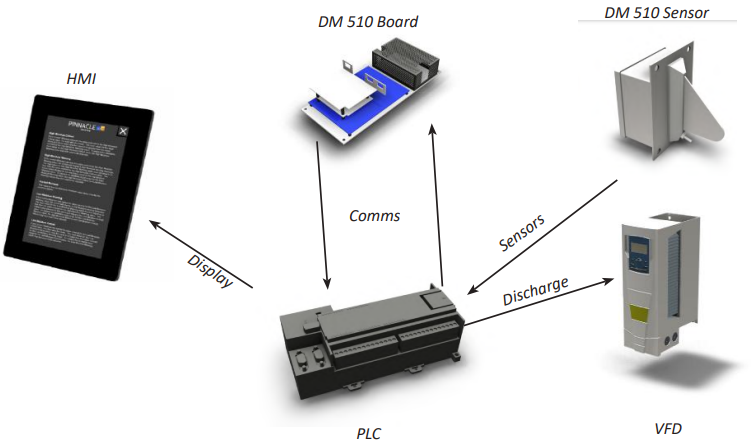
AccuDry technology utilizes the Dryer Moisture Systems Dryer Master DM510 system. The DM510 system uses specially designed in-line moisture and temperature sensors located at both the infeed and discharge of the dryer. These sensors provide continuous moisture and temperature readings to the PLC, which is shared with the DM510 logic board.
The DM510 board uses this information to build an operating model of your dryer. As infeed moistures and drying conditions change throughout the day; AccuDry continuously calculates and automatically adjusts to the optimum discharge rate for current conditions.
AccuDry has two important advantages. First, in automatic mode, it can continually watch the dryer. It does not have to help unload trucks, load trains, or do any other jobs around the elevator that a normal dryer operator does throughout the day. The dryer receives the user's full attention.
Second, it has the benefit of continuous moisture information from both the infeed and discharge of the dryer, giving it a complete picture of all the grain in the dryer, and the grain exiting the dryer.
With this information, AccuDry does not have to wait to react to changes in the outlet moisture. It is able to adjust the discharge rate as the incoming moisture changes. For example, as wetter grain comes into the dryer, AccuDry begins to slow down the discharge rate just as the wetter grain reaches the hot zone.
---
# Agent Instructions
This documentation is published with GitBook. GitBook is the documentation platform designed so that both humans and AI agents can read, navigate, and reason over technical content effectively. Learn more at gitbook.com.
## Querying This Documentation
If you need additional information that is not directly available in this page, you can query the documentation dynamically by asking a question.
Perform an HTTP GET request on the current page URL with the `ask` query parameter, and the optional `goal` query parameter:
```
GET https://docs.mathewscompany.com/pinnacle-2020/pinnacle-20-or-20-controls/system-settings/discharge-speed-control/accudry-settings/how-accudry-works.md?ask=&goal=
```
`ask` is the immediate question: it should be specific, self-contained, and written in natural language.
`goal` is optional and describes the broader end goal you are ultimately trying to accomplish on behalf of the user. GitBook uses it to tailor the answer towards what is most useful for that goal.
The response will contain a direct answer to the question and relevant excerpts and sources from the documentation.
Use this mechanism when the answer is not explicitly present in the current page, you need clarification or additional context, or you want to retrieve related documentation sections.